Paintings for the Bedroom: What Works and Where
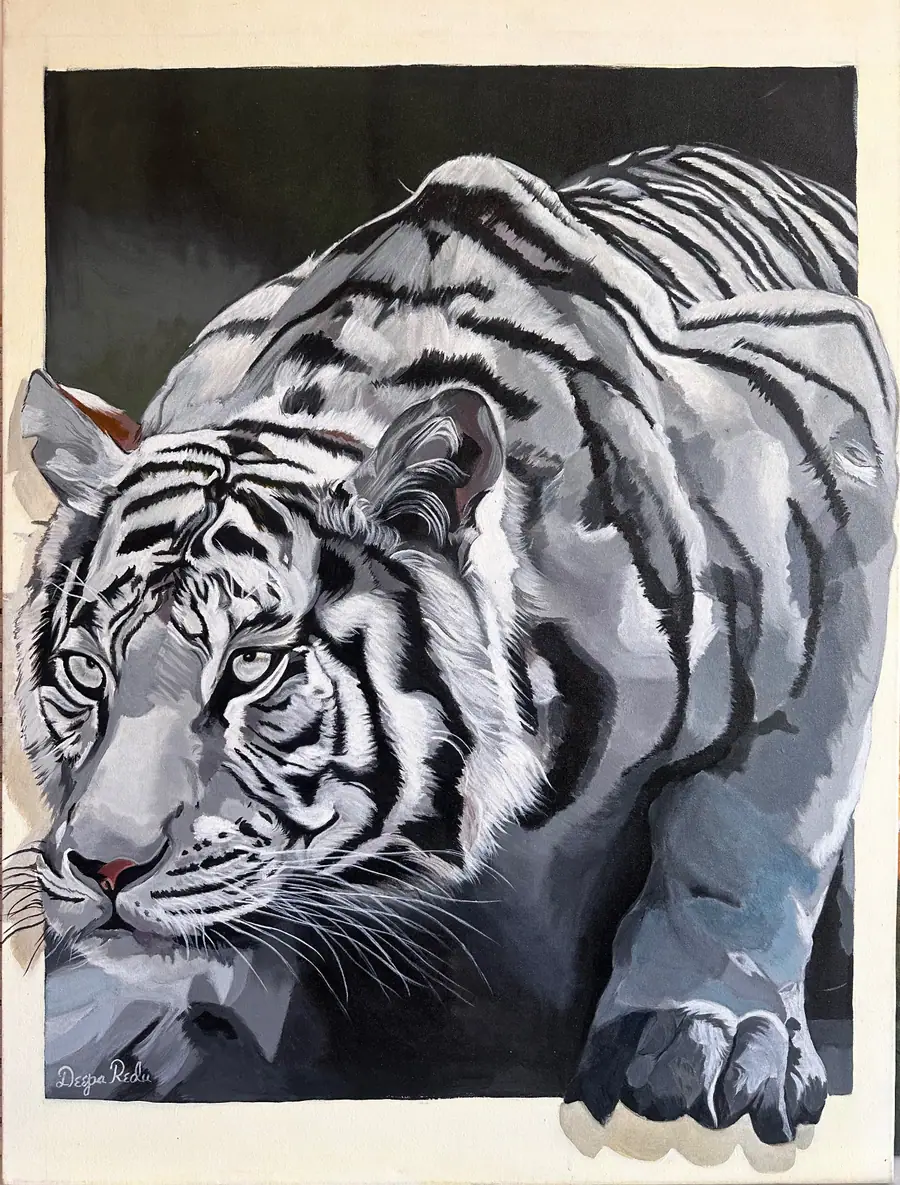
Lie on the bed and look straight ahead. The wall you are facing is the most important one in the room, and it is usually the one with a cupboard, a calendar or nothing at all on it. The wall above the headboard gets all the attention in photographs, yet you hardly see it once you are in bed.
So if you are buying one painting for a bedroom, consider hanging it opposite the pillow.
The wall you wake up to
You will look at this picture half asleep, in weak light, hundreds of times a year. It wants some stillness. Water, distant hills, mist, a bird on a branch, a figure turned away: these work. A face with a direct gaze is harder to live with here than people expect.
Size matters less on this wall since there is no furniture to relate to. Between 60 and 90 cm wide (24 to 36 inches) suits most rooms with about three metres between bed and wall. Because you are looking up slightly from a pillow, normal hanging height or even a little above it is right, with the centre at 145 to 155 cm (57 to 61 inches) from the floor.
Above the headboard
| Bed | Bed width | Width of art |
|---|---|---|
| Single | 91 cm (36 inches) | 50 to 65 cm (20 to 26 inches) |
| Queen | 152 cm (60 inches) | 100 to 115 cm (40 to 45 inches) |
| King | 183 cm (72 inches) | 120 to 135 cm (48 to 54 inches) |
Indian beds vary, and many headboards are wider than the mattress. Measure the headboard itself and take two thirds of that. Leave 15 to 20 cm (6 to 8 inches) between it and the frame.
Two upright works side by side look good over a bed, one for each half. So does one long landscape. Three small pictures in a row tend to look bitty above something as heavy as a king-size bed.
Make it safe
A painting over sleeping people needs more care than one in a hallway.
- Choose unframed canvas or a light wooden frame, with acrylic glazing if it must be glazed
- Use two fixings, each able to carry the full weight by itself
- In brick or concrete, drill and use a wall plug and screw
- Stick felt or rubber pads to the lower corners so the frame cannot slide sideways
- Never rely on adhesive strips here
Solid wood headboards that bang against the wall will loosen hooks over the years. Give everything a gentle tug at Diwali cleaning time.
Subjects that settle
Nature and landscape is the obvious room to look in, and it is obvious for a reason. A low horizon gives the eye somewhere to rest. Soft-edged abstracts do the same thing without showing you a place.
Drawings and works on paper are at their best in bedrooms. They are quiet, they reward being looked at from close by, and bedrooms are often darker than living rooms, which suits paper. Keep the light off them all the same: heavy curtains drawn at midday do more for a watercolour than any special glass.
Animals are fine if they are resting. Elephants walking away down a track, yes. A leopard mid-leap, perhaps in the study.
Colour at night
Bedrooms are seen mostly under lamps. Warm bulbs push everything towards yellow, so a painting that depends on clean whites and icy blues will look murky after eight o'clock. Muted greens, ochres, indigo and grey survive lamplight well.
Ask the artist for a photo taken indoors in the evening. It takes them a minute, and it will tell you more than the listing picture.
Children's rooms and guest rooms
Hang lower for children, with the centre near 110 to 120 cm (43 to 47 inches), and use acrylic in place of glass. Choose something they can grow with. An original drawing of an animal they love will still be wanted at fifteen, when the cartoon stickers have long since come down.
A guest room is a good home for the odd purchase that fits nowhere else. Guests look at things properly, since it is all new to them.
A note on direction
Some families follow vastu about which images face which way, and advice differs from one household to the next. Ask whoever you trust on it before the drill comes out. Moving a hook later leaves a hole.
Test your shortlist on a photo of the actual wall in the visualizer. Stand where the pillow is when you take the picture.