Choosing Paintings for an Office or Workplace
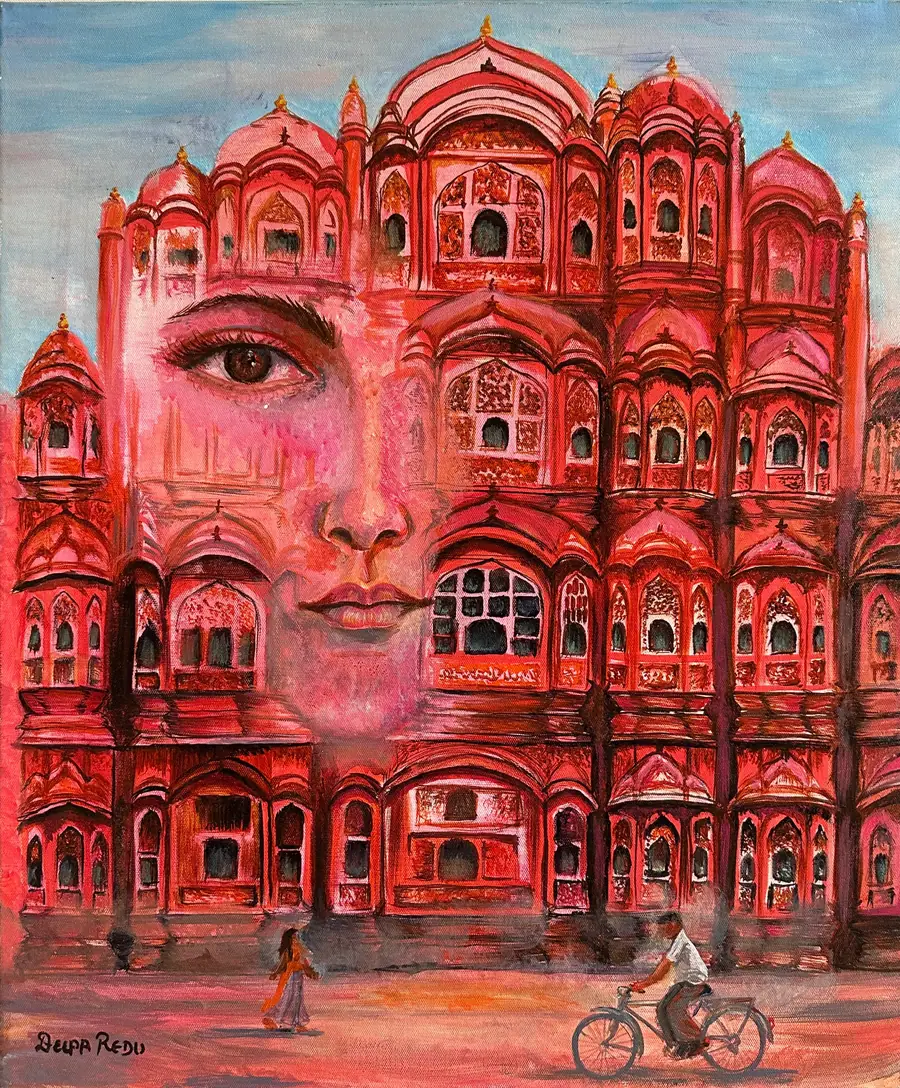
Art for an office has to please people who did not choose it and will see it five days a week. It also has to get past the accounts department. Both are easier if you plan by room and settle the paperwork before anyone falls in love with a canvas.
Reception
Visitors see this wall from 3 to 5 metres away, then again from a sofa for ten minutes while they wait. You need something that holds at both distances. One large work, 120 to 180 cm wide (47 to 71 inches), does more than a row of small ones.
Check what is already on the wall. A company logo and a painting on the same surface will fight, so give them separate walls or leave at least a metre between. If the reception desk stands in front, hang the work so its lower edge clears the top of a standing receptionist's monitor, and look at it from the visitor's side.
Regional subjects make good sense here. A Chennai office with a painting of its own coast gives a visitor something to talk about. Indian culture is a good room to begin in.
Cabins and home offices
Think about what appears behind you on a video call. Most webcams show a strip of wall roughly 120 to 150 cm wide. A single painting around 60 x 75 cm (24 x 30 inches), hung off-centre so it sits beside your head, looks far better than one growing out of the top of it. Open your camera and tape up a sheet of paper before you commit. Avoid glass, because the ring light will show in it.
The wall you face is for you. Put something there that is restful at 4 pm.
Meeting rooms
Keep it away from the screen wall and the whiteboard. Long horizontal works suit the side wall, with the centre lower than usual, about 130 to 135 cm (51 to 53 inches), since everyone is seated. Abstract painting is a sensible default: nobody has to interpret a figure in the middle of a difficult negotiation.
Glass walls rule out hanging. Use the solid wall, however dull it looks, or a floor easel if the room is small and calm.
Corridors
Corridors are the cheapest place to make an office feel looked after. People walk past at arm's length, so this is the place for small detailed works that would be lost in a lobby. Six drawings in identical frames, 40 x 50 cm each (16 x 20 inches), spaced evenly, will fill about five metres.
Check the width of the passage and any fire-safety clearance, and keep frames slim. A deep frame on a narrow corridor will be knocked by trolleys.
Things to settle before buying
| Matter | Who decides |
|---|---|
| Budget per room, with framing and fixing | Facilities and finance |
| Invoice format and tax treatment | Your accountant |
| Whether the work goes on the asset register | Your accountant |
| Insurance while on the premises | Your insurer |
| Permission to use images in brochures or film | The artist, in writing |
That last one is often forgotten. Owning a painting does not usually include the right to print it on a calendar, and if it appears prominently in an advertisement you should have asked. Most artists will agree to a sensible request. Our page of questions for the artist covers the wording.
Individual artists may not be set up like your regular vendors. Some have no GST registration, and few will wait ninety days to be paid. Find this out at the first message. An advance with the balance on delivery is fair to a person working alone.
Fixing and security
Offices are full of gypsum partitions, which will not hold a heavy frame on an ordinary screw. Ask the facilities team for the stud positions, or use fixings made for hollow board and rated well above the weight. In public areas, security hangers that need a small spanner to release cost little and stop frames from being lifted off or tilted by the cleaning crew.
Tell the housekeeping team in plain words: dry dusting of the frame only, nothing sprayed. Glass cleaner sprayed on a frame runs under the edge and soaks into the mount.
Choosing without a committee of twelve
Let three people choose. Give them a limit, two rooms of the gallery to look in, and one week. Ask each for four works, then see what overlaps.
Every piece on Wallhance is an original, so a set of six from one artist will be six individual works, and you deal with that artist directly about price and timing. If you need a particular size for a difficult wall, a commission may be simpler. Allow two months or more, and read how commissioning works first; the same steps apply to landscapes and abstracts.