Graphite and Charcoal Drawings: A Buyer's Guide
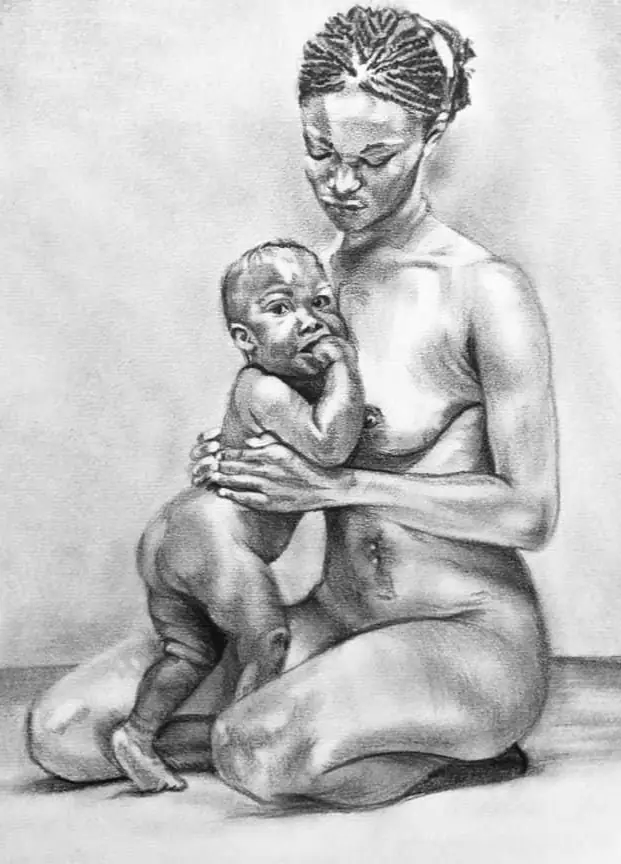
Drawings are often the most affordable way into a serious artist's work, and they are the closest you can get to it. You can see the hand changing its mind. They are also easy to damage with one careless thumb, so a little knowledge helps.
Two kinds of black
Graphite is a crystalline form of carbon, ground and mixed with clay to make pencil leads. More clay gives a harder, paler line, marked H. Less clay gives a softer, darker one, marked B. A finished pencil portrait may have used everything from a 2H for the first faint structure to an 8B for the pupils of the eyes.
Charcoal is burnt wood. Willow and vine charcoal come as plain sticks that make a light, dusty mark you can wipe off with a cloth. Compressed charcoal is powdered, bound and pressed into sticks or pencils, and it is far blacker and more stubborn.
Tilt a drawing towards a window and the two give themselves away. Heavy graphite shines like wet slate. Charcoal stays matt however dark it goes. That shine is why some artists will not use graphite for a large black background, and why a photograph of a dense pencil drawing often shows a grey glare.
| Graphite | Charcoal | |
|---|---|---|
| Darkest tone | Deep grey with a sheen | True matt black |
| Line | Fine and precise | Broad, soft, easily smudged |
| Typical size | Small to medium | Medium to very large |
| Suits | Hair, lace, feathers, architecture | Mass, light, gesture |
| Fixative | Useful, sometimes skipped | Nearly always needed |
How artists work them
A detailed graphite drawing is slow. Tone is built in many light passes, and an A3 portrait can occupy a week or more. The skill to look for is patience with the middle greys. Beginners jump from pale to dark and leave nothing between.
Charcoal rewards a bolder approach. One common method is to cover the whole sheet with a grey layer, then lift out the lights with a kneaded eraser and push in the darks. The eraser becomes a drawing tool. You will see it in the glint of an eye or the rim of a brass pot, and those whites have an energy that careful shading rarely matches.
Many artists mix the two, or add white chalk on toned paper so that the sheet itself supplies the middle tone. Conté crayons, in black, white and a reddish brown called sanguine, belong to the same family.
Fixative and what it can do
Fixative is a thin resin sprayed over the surface to hold loose particles. It reduces smudging. It does not make the drawing waterproof, and it will not survive a rub with a sleeve. Heavy spraying darkens charcoal and can dull the whites, so artists often fix in light coats and then restate the highlights.
Ask whether a drawing has been fixed. If it has not, that may be a considered choice, but then it should travel flat with a sheet of glassine over it and should never be rolled.
What to look for in a portrait
Check the far side of the face first. In a three-quarter view the far eye sits closer to the nose than people expect, and weaker drawings flatten it. Then look at the edges. If every edge is equally sharp, the head will look cut out and pasted on. A confident artist lets the shadowed ear or the back of the hair dissolve.
Working from a photograph is common and is nothing to hide. What matters is whether the artist understood the form or merely matched greys. Hands are a good test.
If you want someone particular drawn, read our notes on commissioning a portrait first. The quality of the photographs you supply decides a lot. Wallhance artists who draw people hang their work in portraits and figures, and there is a separate room for drawings and works on paper.
Framing and hanging
Both media are carbon, so neither will fade. The paper is the weak point. Ask for acid-free paper, and frame with an acid-free mount so the surface does not touch the glass. Choose real glass for charcoal, because acrylic sheet builds up static and can pull particles off the paper. The full method is in our guide to framing works on paper.
Reflections bother drawings more than paintings, since the darks turn into a mirror. Hang the work at right angles to a window if you can, or pay a little extra for anti-reflective glass.
Common questions
What is the difference between graphite and charcoal? Graphite is carbon mixed with clay. It gives a fine, precise line and a deep grey with a sheen. Charcoal is burnt wood. It gives a true matt black and smudges easily.
Do graphite and charcoal drawings fade? No. Both are carbon. The paper is the weak point, so ask for acid-free paper and an acid-free mount.
Should a drawing be framed under glass or acrylic? Choose real glass for charcoal, because acrylic sheet builds up static and can pull particles off the paper. The mount should keep the surface away from the glass.
Does fixative make a drawing waterproof? No. It holds loose particles and reduces smudging, but it will not survive water or a rub with a sleeve.